Capacitors for AI Chipset Bypass, Decoupling and Filtering: 2025 Global Technologies and Opportunities
09/08/2025 //
AI'S EXPLOSIVE GROWTH IS RESHAPING CAPACITOR MARKET DYNAMICS IN 2025
The artificial intelligence (AI) revolution has captured global attention through breakthrough applications in generative AI, autonomous systems and machine learning, which is impacting the semiconductor ecosystem and its key support passive electronic components. This article looks at the capacitors employed for bypass, decoupling and filtering which is required for fundamental operation of the design. Furthermore, these cornerstone passive parts employ a suite of raw materials considered primary building blocks for next generation electrical and electronic technologies.
CAPACITOR BYPASS, DECOUPLING AND FILTERING IN AI CHIPSETS
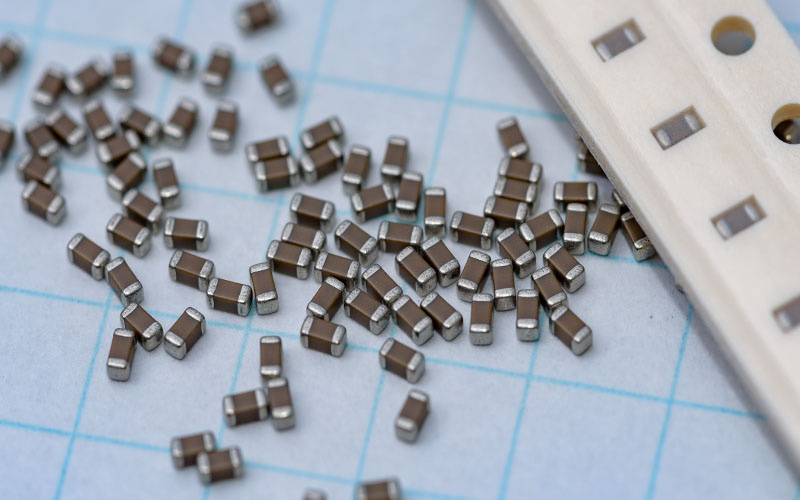
AI chipsets demand unprecedented semiconductor bypass and decoupling features and chipset power filtering at elevated temperatures. Each of these functions is accomplished with a dielectric well of energy in the form of a capacitor. These parts are volumetrically efficient and are so small that some case sizes border on the invisible (01005 MLCC and embedded silicon, for example) and represent one of the most significant technical and commercial opportunities in passive electronic components. The following is a description of the fundamental capacitor function in the semiconductor operation and its power efficiency.
Capacitor Bypass Function in AI Chipsets
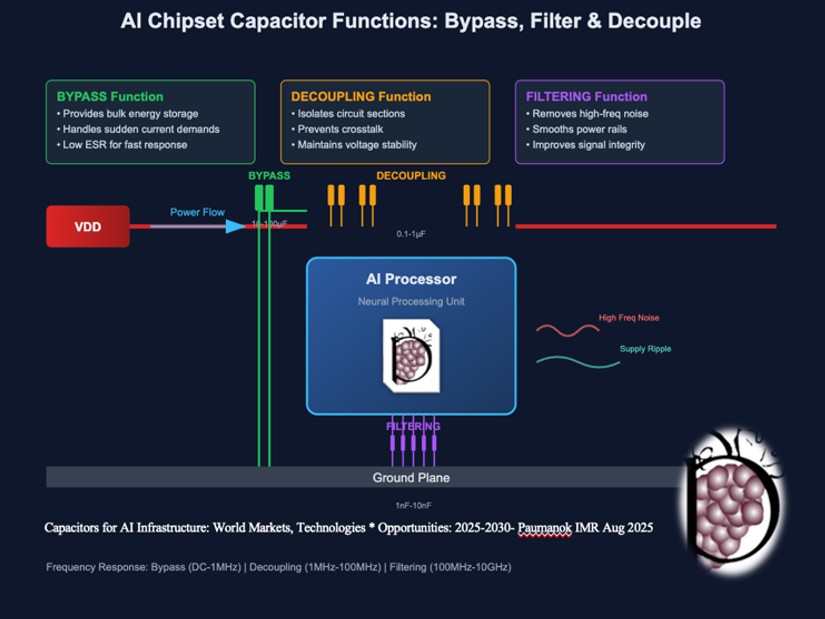
Capacitors provide a bypass function in AI chipsets, which is a rapid supply of energy from a well of capacitance for the purpose of bypassing an isolated circuit. This function requires low equivalent series resistance in the capacitor, which is a function of raw material selection.
Capacitor Decoupling Function in AI Chipsets
Capacitors also provide a decoupling function in AI chipsets, whereby the well of capacitance isolates circuit sections at specific voltages and prevents crosstalk between those sections.
Capacitor Filtering Function in AI Chipsets
Capacitors provide a filtering function in AI chipsets, whereby the well of capacitance filters out unwanted power and signal noise at heightened temperatures and in close proximity to the semiconductor and other passive components. (See Figure 1)
Figure 1.0: Capacitor Functions in AI Chipsets
Source: Paumanok Publications, Inc. All Rights Reserved
TYPES OF CAPACITORS CONSUMED IN AI CHIPSETS BY TYPE AND CIRCUIT FUNCTION
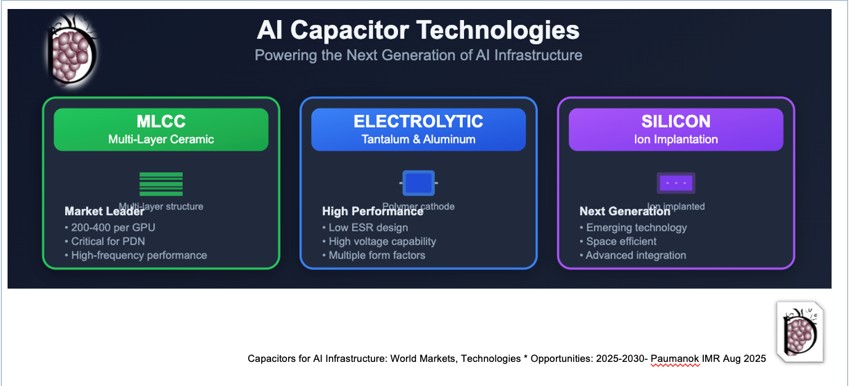
Multilayered ceramic chip capacitors (MLCCs), solid polymer tantalum, solid polymer aluminum and silicon type capacitors are all consumed for various bypass, decoupling and filtering applications in AI chipsets. Their selection depends upon their most logical placement in service to the needs of the active component.
Here is a description of those capacitor products and the reason why their specific performance criteria is required.
Multilayer Ceramic Chip Capacitors
MLCCs dominate this market opportunity for bypass and decoupling in 2025, due to their critical role in power delivery network (PDN) designs for high-performance AI processors. Graphics processing units (GPUs) optimized for AI workloads require 200-400 MLCCs per device, compared to 50-100 capacitors in comparable traditional computing applications. MLCCs compete with silicon dielectric capacitors in the ongoing quest of providing wells of volumetrically efficient capacitance for AI chipset decoupling.
Silicon Capacitors
Emerging dielectrics that are important for AI Infrastructure include silicon capacitors produced using ion implantation devices. These silicon capacitors are the next step in volumetrically efficient chip design and can extend the volumetric efficiency to next-generation levels where performance requirements are mitigated through proximity to the active component.
Tantalum and Aluminum Electrolytic Capacitors
Electrolytic type capacitors, with emphasis upon solid polymer tantalum and solid polymer aluminum electrolytic designs, offer a polymer cathode version with low equivalent series resistance (ESR) that lends itself to rapid cycling at high voltage, high capacitance and in a very small case size. These devices are consumed in power management applications and their solid-state polymer cathode design works well in modules with limited real estate and heavy loads of activity (See Figure 2.0).
Figure 2.0: Capacitors Consumed in AI Chipsets by Type and Application
Source: Paumanok Publications, Inc. All Rights Reserved
THE IMPORTANCE OF POWER INTEGRITY IN AI CHIPSETS
Modern AI processors operate differently from traditional processors, creating unique demands for bypass and decoupling capacitor solutions. Leading AI GPU processors contain 80 billion transistors switching at frequencies up to 3 GHz while drawing instantaneous currents exceeding 400 amperes. Other AI processors incorporate two dozen tensor processing cores (TPCs) operating simultaneously, each requiring independent power rail management with reliable integrity.
In addition, AI inference processing creates particularly challenging power delivery scenarios. Computational loads can transition from idle to maximum in nanoseconds. This creates power delivery transients that exceed the capabilities of conventional decoupling systems.
The thermal environment compounds these challenges. AI data centers operate at elevated temperatures to maximize efficiency, often meeting or exceeding 105°C ambient conditions. Bypass capacitors must maintain electrical performance under these thermal stresses while occupying minimal board real estate in increasingly dense processor layouts.
High-Frequency Capacitor Filtering Requirements
AI chipsets require that each isolated power rail requires dedicated filtering to prevent cross-coupling between processing cores while maintaining power delivery efficiency. This creates demand for compact, high-performance filter networks that can be implemented in the confined spaces around AI processors.
Ferrite bead inductors combined with specialized MLCCs, or embedded silicon, create the filtering networks essential for AI chipset EMI control.
Decoupling Network Architecture for AI Processors
The massive parallel processing capabilities of AI chips create simultaneous switching events across hundreds of processing cores, generating power delivery transients that exceed the capabilities of conventional decoupling approaches. The decoupling architecture typically employs a three-tier approach: bulk decoupling using large-value MLCCs for energy storage, mid-frequency decoupling with medium-value capacitors for transient response and high-frequency bypass using ultra-low ESL capacitors for switching noise suppression. Each tier requires optimization for AI's specific switching characteristics.
Advanced Packaging Integration
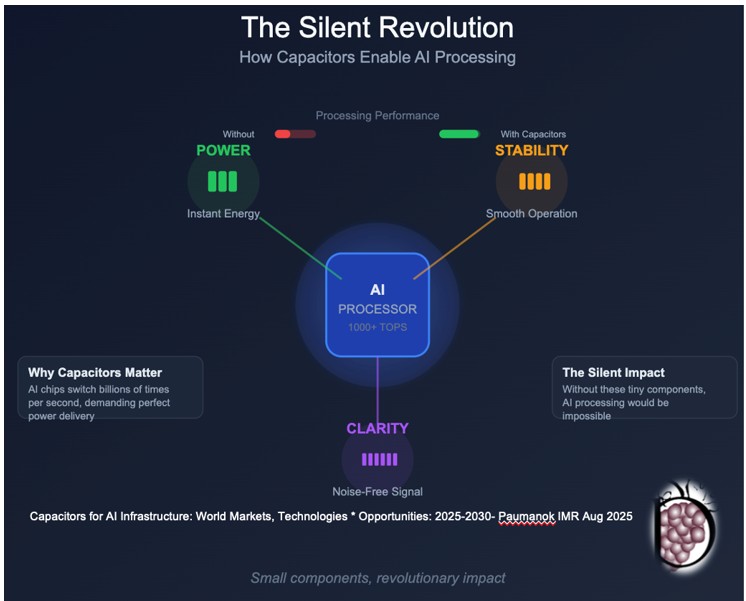
The extreme power delivery requirements of AI chipsets are driving integration of capacitors directly into advanced packaging substrates in the form of embedded silicon capacitors. This approach maximizes decoupling capacitor density in proximity around the processor die. Embedded silicon capacitor technologies are becoming essential for AI applications. The movement to quantum processing will further test new dielectrics such as sapphire, diamond and boron nitride. (See Figure 3.0)
Figure 3.0 – Power, Stability and Signal Clarity in AI Architecture Through Applied Capacitance
Source: Paumanok Publications, Inc. All Rights Reserved
TECHNOLOGY REQUIREMENTS AND INNOVATION DRIVERS: 2025-2030
The following offers a technology roadmap for capacitors used for bypass, decoupling and filtering AI chipsets.
AI Chipset Power Delivery and Impact on Capacitor Performance Requirements
AI chipset power delivery demands are redefining capacitor performance specifications across multiple dimensions. Ultra-low voltage operation (0.6V to 1.2V) combined with extreme current densities (>100A per chip) creates stringent requirements for equivalent series resistance (ESR), equivalent series inductance (ESL) and thermal performance (105°C) that exceed traditional computing applications.
AI Chipset Advancement and Impact on Capacitor Performance Requirements
The transition to advanced AI architectures, specifically cryogenic-based quantum-classical hybrid systems, drives continuous innovation in capacitor technologies, including ceramic and silicon but also next-generation capacitor technologies such as graphene, hexagonal boron nitride, niobium oxide and diamond for decoupling the quantum processing unit (QPU).
AI Chipset Package Level Integration and Impact on Capacitor Types and Physical Size
Package-level integration emerges as a critical technology trend, with system-in-package and chiplet architectures requiring embedded silicon capacitors that operate within millimeters of AI processor cores. Silicon capacitor technology and 3D capacitor structures enable capacitance densities exceeding 1000µF/mm², supporting the miniaturization requirements for edge AI applications while maintaining the electrical performance necessary for high-current power delivery.
AI Chipset Package Level Integration and Impact on Capacitor Temperature Performance
Capacitors consumed in AI Chipsets require 105°C operation. Advanced packaging technologies, including 2.5D interposers and through-silicon vias (TSVs), create new opportunities for capacitor integration at the package level, reducing power delivery network inductance while enabling higher power densities. These developments favor capacitor manufacturers with next-generation advanced materials expertise and semiconductor manufacturing capabilities.
CONCLUSION
The intersection of artificial intelligence growth and capacitor technology represents one of the most significant opportunities in passive components. The unique power delivery challenges of AI chipsets are driving fundamental innovations in bypass, filtering and decoupling capacitor technologies while creating substantial market growth opportunities for passive component investors in next-generation dielectrics and technology.
Success in this market requires a deep understanding of AI processor power delivery requirements, advanced technical capabilities in high-frequency capacitor design and strategic relationships with AI ecosystem participants. Companies that can align their technology roadmaps with AI development while building scalable manufacturing capabilities will capture exceptional value from this transformational market opportunity.
Paumanok Publications, Inc. is the world's largest supplier of market research and consulting services to the passive electronic component industry. For 36 years, Paumanok has supplied research products and services for trade companies and private equity firms that have a financial interest in or are directly involved in the supply chain for capacitors, resistors, inductors and circuit protection components, as well as the engineered materials and ores associated with their key functions.
Follow TTI, Inc. on LinkedIn for more news and market insights.
Statements of fact and opinions expressed in posts by contributors are the responsibility of the authors alone and do not imply an opinion of the officers or the representatives of TTI, Inc. or the TTI Family of Specialists.
Follow TTI, Inc. - Europe on LinkedIn for more news and market insights.
Statements of fact and opinions expressed in posts by contributors are the responsibility of the authors alone and do not imply an opinion of the officers or the representatives of TTI, Inc. or the TTI Family of Specialists.
Dennis M. Zogbi

Dennis M. Zogbi is the author of more than 260 market research reports on the worldwide electronic components industry. Specializing in capacitors, resistors, inductors and circuit protection component markets, technologies and opportunities; electronic materials including tantalum, ceramics, aluminum, plastics; palladium, ruthenium, nickel, copper, barium, titanium, activated carbon, and conductive polymers. Zogbi produces off-the-shelf market research reports through his wholly owned company, Paumanok Publications, Inc, as well as single client consulting, on-site presentations, due diligence for mergers and acquisitions, and he is the majority owner of Passive Component Industry Magazine LLC.