Mapping the Complex MLCC Ecosystem
10/11/2023 //
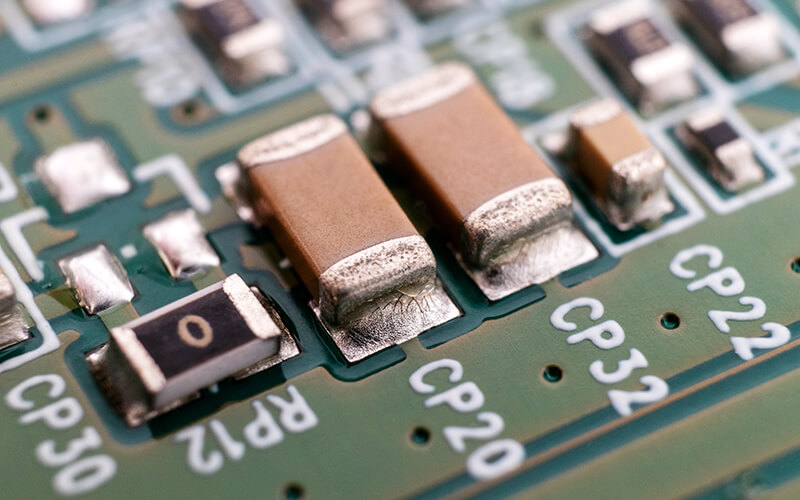
Within the expansive capacitor market, two primary sub-segments take center stage: (1) electrostatic capacitors and (2) electrolytic capacitors. The former encompasses the versatile world of ceramic capacitors, including the omnipresent multi-layered ceramic chip capacitors (MLCCs) alongside plastic film capacitors. Meanwhile, the latter sub-segment features aluminum electrolytic and tantalum electrolytic capacitors.
In this spoke of our research, we embark on a comprehensive exploration of the capacitor technologies included in our coverage scope. It is essential to recognize that technology plays a pivotal role in enhancing market value through product differentiation. Our technology overview aims to provide an intricate examination of the inner workings of each capacitor within our report's purview. We delve deep into the performance attributes of these capacitors, dissect the materials employed in their construction and illuminate the intricate manufacturing processes that contribute to their value as passive components within larger systems.
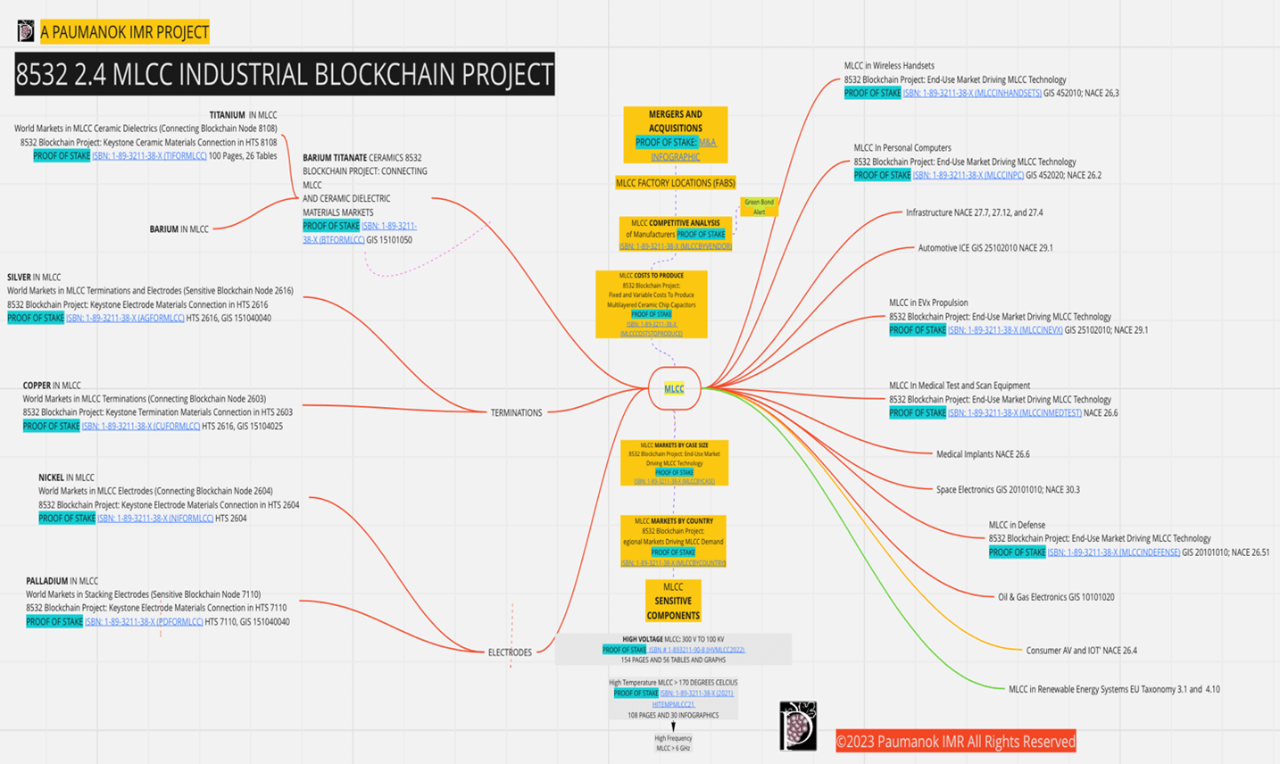
Figure 1.0: The Complex Ecosystem for Multilayered Ceramic Chip Capacitors
CERAMIC CAPACITOR TECHNOLOGY OVERVIEW AND ANALYSIS
The capacitor market is broadly categorized into two main segments: (1) electrostatic and (2) electrolytic capacitors. Within these segments, various product lines cater to different applications. This section provides a detailed overview and analysis of ceramic capacitors, a crucial technology contributing to product differentiation and market value.
CERAMIC CAPACITOR TYPES
Ceramic capacitors come in two fundamental constructions: multilayered and single layered.
Multilayered Ceramic Capacitors (MLCCs)
Produced using an alternate stack process, MLCCs consist of layers of ceramic dielectric material interleaved with metallized electrodes. MLCCs are available in both surface mount and leaded designs and are widely favored by global design engineers for applications such as bypass, decoupling and filtering circuits due to their versatility.
Single Layer Ceramic Capacitors
Comprising pressed ceramic materials with a single thick ceramic layer coated with silver metallized electrodes, these capacitors are primarily manufactured in Japan, Taiwan and China and find use in high voltage television flyback transformers and specialized defense electronics power supplies.
CERAMIC CAPACITOR CONFIGURATIONS
Ceramic capacitors are available in two primary configurations: surface mount and through-hole (chip and leaded).
Surface Mount Ceramic Chip Capacitors (MLCCs)
These capacitors come in various case sizes, including ultra-small sizes like 0402, 0201 and 01005 as well as larger sizes like 0603 and 0805. High-capacitance MLCCs generally start at the 1206 case size and go up to 2220 case size. MLCCs are the most widely consumed capacitors in the market.
Leaded Ceramic Capacitors
Leaded capacitors come in multilayered axial and radial configurations as well as single layered designs. Some specialty single-layered capacitors are available in "doorknob" configurations for high voltage applications.
MLCC DESIGN
MLCCs are produced using an alternate stack process, allowing for the stacking of over 1,500 layers. They are the preferred choice for global design engineers for various circuit applications. Although MLCCs have limitations in capacitance, advancements continue to expand their capabilities by stacking varying layers of ceramic and metal.
Figure 2.0: The Multilayered Ceramic Chip Capacitor Basic Design
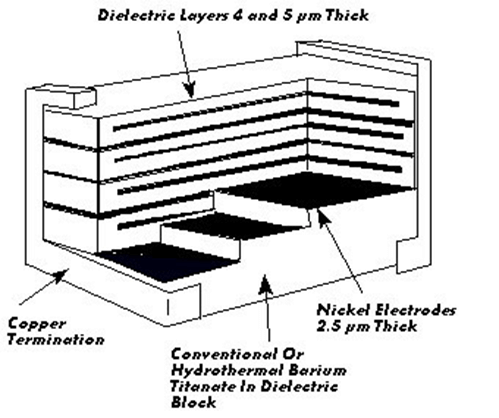
Source: ©2023 Paumanok IMR - Drawing by Dennis Zogbi. The key to the high capacitance MLCC market competition in 2023 is the ability for manufacturers to stack increasingly larger number of layers in the same footprint.
MLCC Electrode Materials
Electrode materials for MLCC can be based upon palladium or nickel. Electrodes based on palladium are cut with silver metal and vary based upon kiln firing temperature. Palladium used to be the primary metal consumed in the MLCC in the 1980s and 1990s but was largely displaced by base metal electrodes since that time. These have been largely based upon nickel but exotic electrode alternatives exist as well. Nickel was viewed as an economically stable metal and not subject to price fluctuations because of its massive consumption as an additive in steel production, but since its adoption as a viable metal for battery applications, its price has been steadily increasing.
MLCC Termination Materials
MLCCs utilize different termination materials based on their electrode materials. Palladium-bearing electrodes require silver terminations while nickel electrodes are paired with copper terminations. The industry has witnessed a substantial shift towards copper termination materials and a decline in silver termination usage.
MLCC Ceramic Dielectric Materials
The primary raw material for ceramic capacitors is the ceramic dielectric material, primarily based on barium titanate. Manufacturers either produce their own barium titanate or source specialty formulations from the merchant market. Advanced production methods, like alk-oxide, hydrothermal and sol-gel techniques are used to control ceramic dielectric material particle sizes.
MLCC Performance Classes
Ceramic capacitors are categorized into three classes based on their dielectric constant (K): Class I, Class II, and Class III. The primary sub-classes include NPO, X7R, Z5U and Y5V, which determine the capacitors' capacitance change with temperature. Class I ceramics like NPO offer the most stable performance, making them suitable for applications requiring excellent stability.
Class II ceramics, including X7R, Z5U and Y5V have high dielectric constants and are used for general-purpose applications. X7R capacitors, while stable, exhibit capacitance variations with temperature, making them suitable for bypass, decoupling, and filtering.
The X5R variation of X7R capacitors offers high capacitance in a small form factor with improved stability compared to Y5V, making them popular for high-capacitance applications.
Z5U capacitors have high-K characteristics with non-linear performance, while Y5V capacitors are similar but have greater temperature coefficients and dissipation factors. Y5V capacitors, despite past performance issues, are widely used in the Far East consumer electronics market.
Class III dielectrics are primarily used in ceramic disc capacitors, offering high volumetric efficiency, leakage resistance and dissipation factor with low working voltage.
PAUMANOK IMR-CERAMIC CAPACITOR TAXONOMY
Within the expansive domain of ceramic capacitors, we classify these components into eight distinctive sub-categories, each representing billions of dollars in market value and varying levels of profitability. Let's embark on a journey through these categories, unveiling the intricacies of each:
Ceramic, 0201 MLCC (0201 BaTiO2)
These minuscule MLCCs measure a mere 0.02 x 0.01 inches, akin to a grain of salt. They are crafted from ceramic dielectric materials in a stacked configuration with solderable metal endcaps. Widely used in wireless handsets and module circuitry, these capacitors enable portable technology, finding applications in bypass, decoupling and filtering circuits. They are produced globally in the hundreds of billions.
Ceramic, 0402 MLCC (0402 BaTiO2)
Similar to their 0201 counterparts, these tiny MLCCs measure 0.04 x 0.03 inches. Their miniature size makes them pivotal in portable technology, including wireless handsets and module circuitry. Like their smaller counterparts, they are used extensively for bypass, decoupling and filtering applications with production soaring into the hundreds of billions. They hold the distinction of being the world's most mass-produced components.
Ceramic, 0603 MLCC (0603 BaTiO2)
With dimensions of 0.06 x 0.03 inches, these compact capacitors find their place in various circuits, although they are relatively larger for modern handsets. Their applications extend to the automotive, industrial and computer sectors serving as indispensable components for bypass, decoupling and filtering tasks. Global production reaches the hundreds of billions.
Ceramic, 0805 MLCC (0805 BaTiO2)
Slightly larger at 0.08 x 0.05 inches, these capacitors maintain their significance in bypass, decoupling and filtering applications. They are widely deployed in the automotive, industrial and computer sectors with global production again reaching the hundreds of billions.
Ceramic, 1206 MLCC (1206 BaTiO2)
Measuring 0.12 x 0.06 inches, these compact capacitors continue to fulfill bypass, decoupling and filtering duties. While they are relatively smaller in volume, they find their place in the automotive and industrial sectors, produced in tens of billions.
Ceramic, 1210-1225 MLCC (1210-1225 BaTiO2)
Spanning dimensions from 0.12 x 0.10 to 0.12 x 0.25 inches, this range caters to value-added and application-specific markets. With production reaching the hundreds of millions, these capacitors serve niche segments such as defense and specialty markets.
Ceramic, High-CV MLCC (All Sizes BaTiO2 in Hydrothermal, Alk-oxide or Sol-gel)
This category encompasses high-capacitance capacitors ranging from 1 microfarad to 100+ microfarad, now even including 220, 330, 470, 680 and 1000 microfarad variants. Crafted from ceramic dielectric materials with nickel electrodes and copper terminations, these capacitors play a pivotal role in bypass, decoupling and filtering across all product lines. They are indispensable for portable technology in handsets and computer tablets.
Ceramic, Specialty Capacitors
This broad category encompasses all ceramic capacitors in chip, axial and radial leaded configurations. They are deployed in high-temperature, high-voltage and high-frequency circuits across infrastructure, defense, oil & gas and medical electronics segments. This diverse category includes safety capacitors, tip & ring capacitors and high-capacitance MLCCs with X5R, Y5V and X7R chemistries and copper terminations, primarily used with nickel electrodes. Monthly reports also track the price per ton for these components.
This comprehensive taxonomy offers a detailed glimpse into the diverse world of ceramic capacitors, highlighting their ubiquity and significance across a multitude of applications and industries.
PLEASE NOTE: Japan and the rest of Asia, as well as all of Europe, employ metric variations of the above components.
UNDERSTANDING THE COMPLEX MLCC SUPPLY CHAIN
To grasp the intricacies of the global capacitors market, it's essential to comprehend the supply chain of passive electronic capacitors. This supply chain spans from the extraction of raw materials to their eventual disposal. In this exploration focused on MLCCs, we shed light on this intricate market, which poses both challenges and opportunities due to its advanced processes and economies of scale.
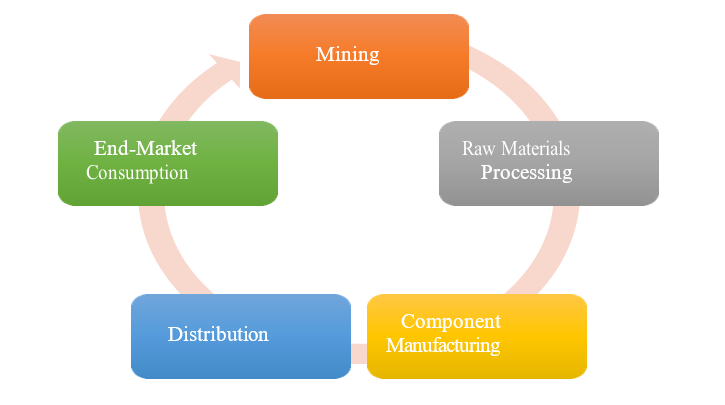
Figure 3.0: The Electronic Component Supply Chain
STREAMLINED OVERVIEW OF THE MLCC SUPPLY CHAIN
Understanding the passive electronic capacitor supply chain is crucial for comprehending the nuances of the global capacitors market. This chain begins with the extraction of raw materials from the earth and concludes with recycling. Focusing on MLCCs, this study unveils the intricacies of a market with advanced processes and significant economies of scale (See Figure 4.0 below for mapping assistance)
Figure 4.0: The Complex Ecosystem for Multilayered Ceramic Chip Capacitors
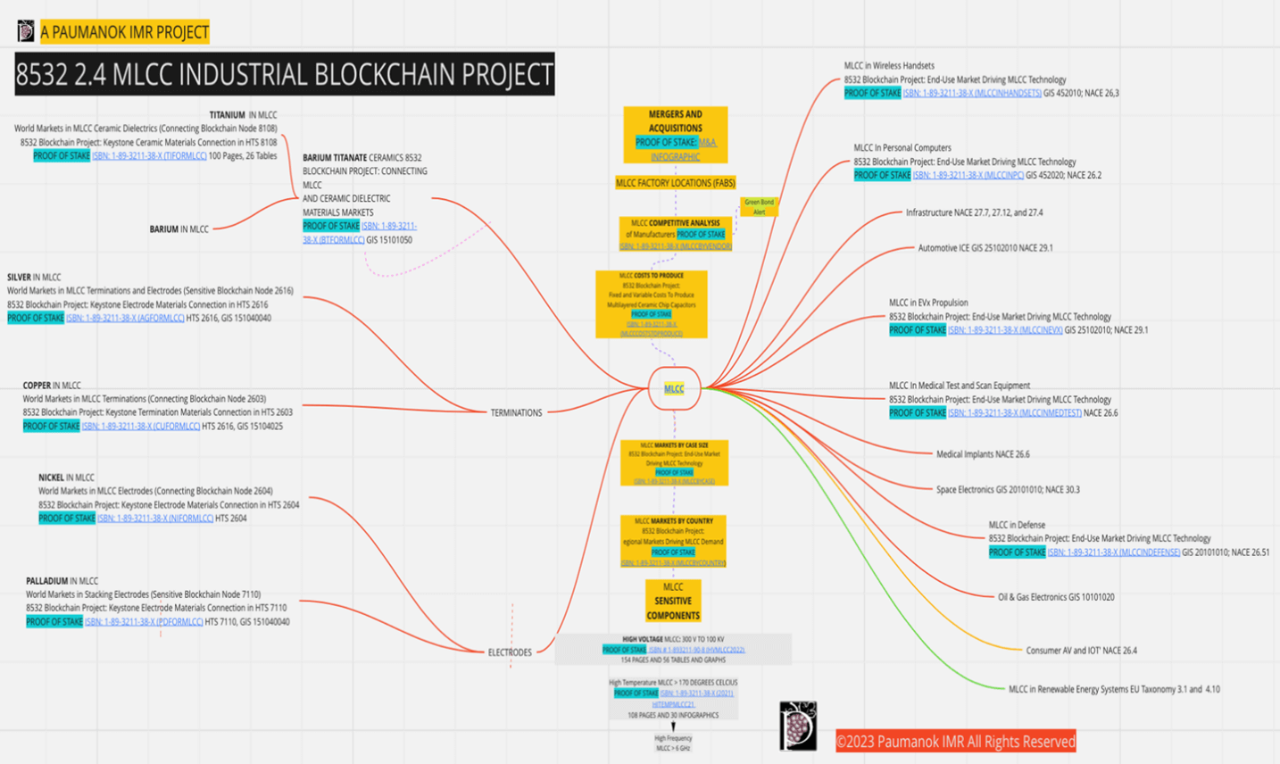
MLCC Mining of Raw Dielectric Materials and Conductive Metals
The supply chain initiates with mining raw materials critical for MLCC production, often classified as rare earths or rare metals. Competition for these materials is intense. Key mined materials for MLCC include barium, titanium, palladium, silver, nickel and copper. Material costs significantly impact overall production expenses.
MLCC Raw Materials Processing
Mined materials must undergo chemical processing to transform them into usable forms for capacitor manufacturing. This process typically bridges the gap between mining and capacitor production. Expertise in nanotechnology is crucial for engineering raw materials as the capacitor's performance directly correlates with its size and available surface area. Engineered raw materials are paramount, with a significant impact on production costs.
For MLCCs, materials like barium carbonate and titanium dioxide are purified, milled and processed into powder. These materials are combined with additives to create formulations, often using barium titanate as the dielectric ceramic material. Metals, such as nickel and copper, are processed into spherical shapes and engineered into a paste or ink.
MLCC Capacitor Manufacturing
Passive electronic capacitors take various forms and require multiple manufacturing processes, including stacking, winding, pressing, and screen-printing of materials. Often, capacitors combine different materials, such as ceramics and metals, to meet specific requirements. Capacitors can be surface mount or come in radial leaded, axial leaded, or multichip array configurations.
Mass-produced MLCCs are created by stacking ceramic formulation layers between electrode layers, terminating with endcaps. These capacitors adhere to industry-standard case sizes defined by organizations like the Electronic Industries Alliance.
MLCC Capacitor Distribution
After manufacturing, capacitors are distributed to customers. Sales can be direct to Original Equipment Manufacturers (OEMs) or Electronic Manufacturing Services (EMS) companies or through authorized distributors. The choice between direct sales and distribution depends on factors like volume and regional preferences.
MLCC End-Market Consumption
MLCCs find applications across various end-markets, including wireless handsets, computers, automobiles, TV sets, industrial equipment, telecommunications infrastructure, defense electronics, medical devices, and oil & gas equipment. Specific products like smartphones, automobiles, and power supplies heavily rely on MLCCs.
MLCC Regional Markets And Key Consuming Countries
The Asia-Pacific region dominates MLCC consumption, accounting for 75% of global usage, with China and Japan being the largest consumers. The Americas and Europe each represent about 12% and 13% of MLCC consumption, with key countries including the USA, Germany, Mexico, Brazil, and various European nations.
MLCC Recycling of Critical Materials
The final stage of the supply chain involves recycling to recover precious and rare metals from discarded MLCCs. Palladium, gold, ruthenium, silver, and tantalum are primary targets for recycling, while materials like nickel, copper, aluminum, and plastic are less commonly recycled due to their lower value.
KEY TECHNICAL ECONOMIC MAXIMS ASSOCIATED WITH MLCCs
Two primary technical factors significantly impact the economics of MLCC production:
Capacitance Requirement
Capacitance is a fundamental requirement for most electronic circuits and MLCCs are the primary choice. Other capacitors like tantalum, aluminum and plastic film capacitors cater to niche markets.
Performance and Surface Area
The performance of an MLCC is directly proportional to its size and available surface area. Engineered raw materials and the stacking of ceramics are pivotal to MLCC performance and production costs.
Capacitance depends on the physical size and available surface area of the dielectric material. Ceramic capacitors are cost-efficient due to the lower price per pound of ceramic dielectric material. This efficiency is achieved through low-cost precursors like barium compounds and titanium dioxide along with the substantial economies of scale resulting from ceramic capacitors dominating global production. Other capacitor types are considered niche markets in comparison.
Paumanok Publications, Inc. is the world’s largest supplier of market research and consulting services to the passive electronic component industry. For 35 years, Paumanok has supplied research products and services for trade companies and private equity firms that have a financial interest in, or are directly involved in the supply chain for capacitors, resistors, inductors and circuit protection components as well as the engineered materials and ores associated with their key functions.
Dennis M. Zogbi

Dennis M. Zogbi is the author of more than 260 market research reports on the worldwide electronic components industry. Specializing in capacitors, resistors, inductors and circuit protection component markets, technologies and opportunities; electronic materials including tantalum, ceramics, aluminum, plastics; palladium, ruthenium, nickel, copper, barium, titanium, activated carbon, and conductive polymers. Zogbi produces off-the-shelf market research reports through his wholly owned company, Paumanok Publications, Inc, as well as single client consulting, on-site presentations, due diligence for mergers and acquisitions, and he is the majority owner of Passive Component Industry Magazine LLC.