Definitions, terms & abbreviations are located at the bottom of the page.
What is a Microswitch?
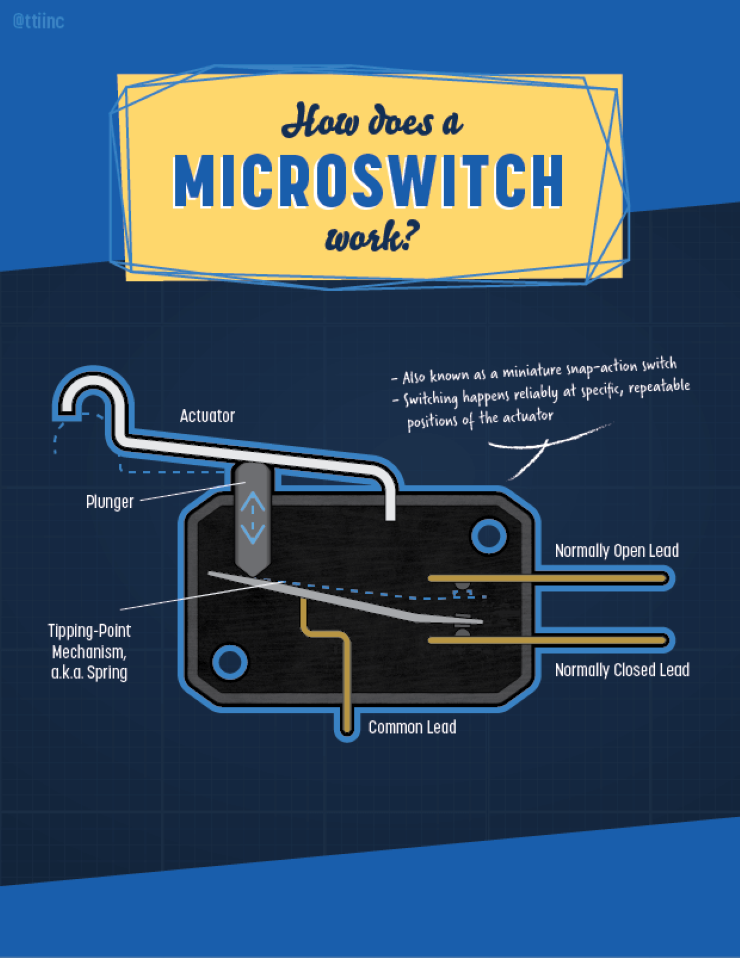
A Microswitch, also known as a miniature snap-action switch, is a small electrical switch activated by little physical force applied to a tipping point or spring mechanism. The press of a button activates a microswitch's rapid snap-action movement of its internal components. This movement either opens or closes the circuit, depending on its initial state, effectively turning the electrical connection on or off.
The first microswitch was invented in 1932 by Phillip Kenneth McGall, an employee of the Burgess Battery Company in Freeport, Illinois. The purpose of microswitches was to create a durable and cost-efficient safety device to replace less reliable and slower switches for home appliances and switch panels.
Microswitch Infographic
Microswitch Functionality
Inside a typical microswitch are three main components: an actuator, a set of stationary contacts, and a movable contact. The actuator is a lever or button designed to respond to physical pressure or movement and is externally accessible. Pressing or pushing the actuator causes the internal spring-loaded mechanism to move, which promptly toggles the position of the movable contact.
A microswitch can either be opened or closed in its default stage. The movable contact does not touch the stationary contacts when the switch is open, this breaks the electrical circuit and prevents the current's flow. But when the switch is closed, the movable contact touches the stationary contacts, thus completing the circuit and allowing electric current to pass through. This rapid change in state occurs with minimal actuation force, making microswitches highly responsive and reliable in various applications.
Microswitches are primarily used in applications where precise control and rapid response are crucial. For example, in household appliances like microwaves, the microswitches are integrated into door latches to ensure the oven operates only when the door is securely closed. In industrial applications, microswitches are used as limit switches to detect the position of moving parts in machinery. Microswitches are also used in automotive applications like brake pedals and gearshift levers to trigger specific functions based on driver input inside a vehicle.
Additionally, microswitches are vital components in user interfaces for devices like computer mice and keyboards, where they register user interactions, providing tactile feedback and ensuring accurate input detection.
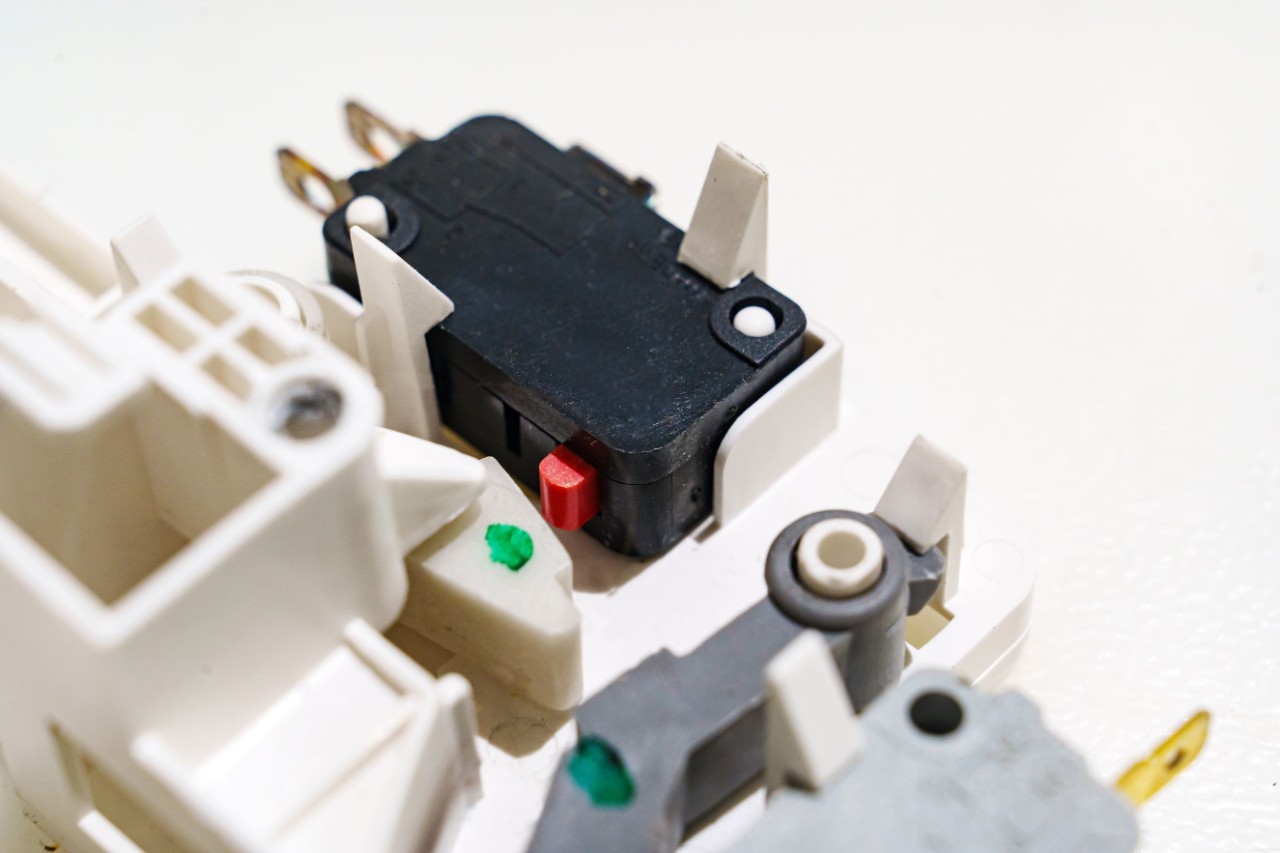 Microswitches are located inside a device's internal structure
Common Microswitch Specifications
Contact Rating: The maximum current and voltage the switch can handle
Actuation Force: The amount of force (grams or Newtons) required to active a switch, microswitches have low actuation forces
Operating Life: the number of cycles (open/close operations) a switch endures before faltering, measured in millions of cycles
Actuator Type: Microswitches have various actuator types like levers, rollers, plungers, and more for specific applications
Termination Style: How a switch connects to a circuit, commonly through solder terminals, quick-connect tabs, or wire leads
Operating Temperature: The range of temperatures (Celsius or Fahrenheit) microswitches can effectively work without damage or malfunction
Housing Material: The material used for the switch housing, often plastic or metal, influences the switch's durability and resistance
Switching Mechanism: Microswitches can use different types of internal mechanisms, like snap-action (rapid changeover), slow-action (gradual changeover), or multiple-circuit (simultaneously controlling multiple circuits)
Protection Rating: Indicates the level of protection against dust and water ingress, following standards like IP65 and IP67
Dimensions: A microswitch's physical size and shape for fitting into specific devices or assemblies
Special Features: Microswitches have a variety of features like high precision, low noise, or specific coatings for enhanced durability or resistance to harsh environments
Key Terms
Actuator: Part of the microswitch that is physically pressed or moved to activate the switch
Contacts: The conductive parts in the switch that enable electrical connections
Terminals: Points on a microswitch used to connect wires or other components
Housing: A microswitches protective casing that encloses its internal components
Spring: Provides the force necessary to return the switch to its original position after actuation
Plunger: Often a button-like extension that is pressed to activate the switch and is a specific type of actuator
Lever: Another type of actuator, usually an extended arm, moved to actuate the switch
Roller: A rotating wheel attached to the actuator, used in some microswitch designs
Snap-Action: The mechanism that ensures rapid changeover of the switch contacts when actuated
Enclosure: The overall casing or housing of the microswitch assembly, providing additional protection
NC (Normally Closed) Contact: A contact that is closed (allowing current to flow) when the switch is not actuated
NO (Normally Open) Contact: A contact that is open (interrupting current flow) when the switch is not actuated
DPDT (Double Pole, Double Throw): A type of microswitch with two separate circuits, each with a normally open and normally closed contact
SPDT (Single Pole, Double Throw): A type of microswitch with one circuit and a single common terminal, but with a normally open and normally closed contact
Key Abbreviations
A: An Ampere is a unit of electric current
μA: A Microampere is equivalent to one-millionth of an ampere
°C: Degrees Celsius is a unit of temperature
°F: Degrees Fahrenheit is a unit of temperature
IP: Ingress Protection indicates the level of protection against dust and water
NC: Normally Closed is a contact that is closed in its normal state
NO: Normally Open is a contact that is open in its normal state
SPDT: Single Pole, Double Throw is a switch with one common terminal and two output terminals
DPDT: Double Pole, Double Throw is a switch with two separate circuits, each with one common terminal and two output terminals
COM: Common is the shared terminal in a switch that connects to either the NC or NO terminal
VAC: Volts Alternating Current is the maximum alternating current voltage the switch can handle
VDC: Volts Direct Current is the maximum direct current voltage the switch can handle
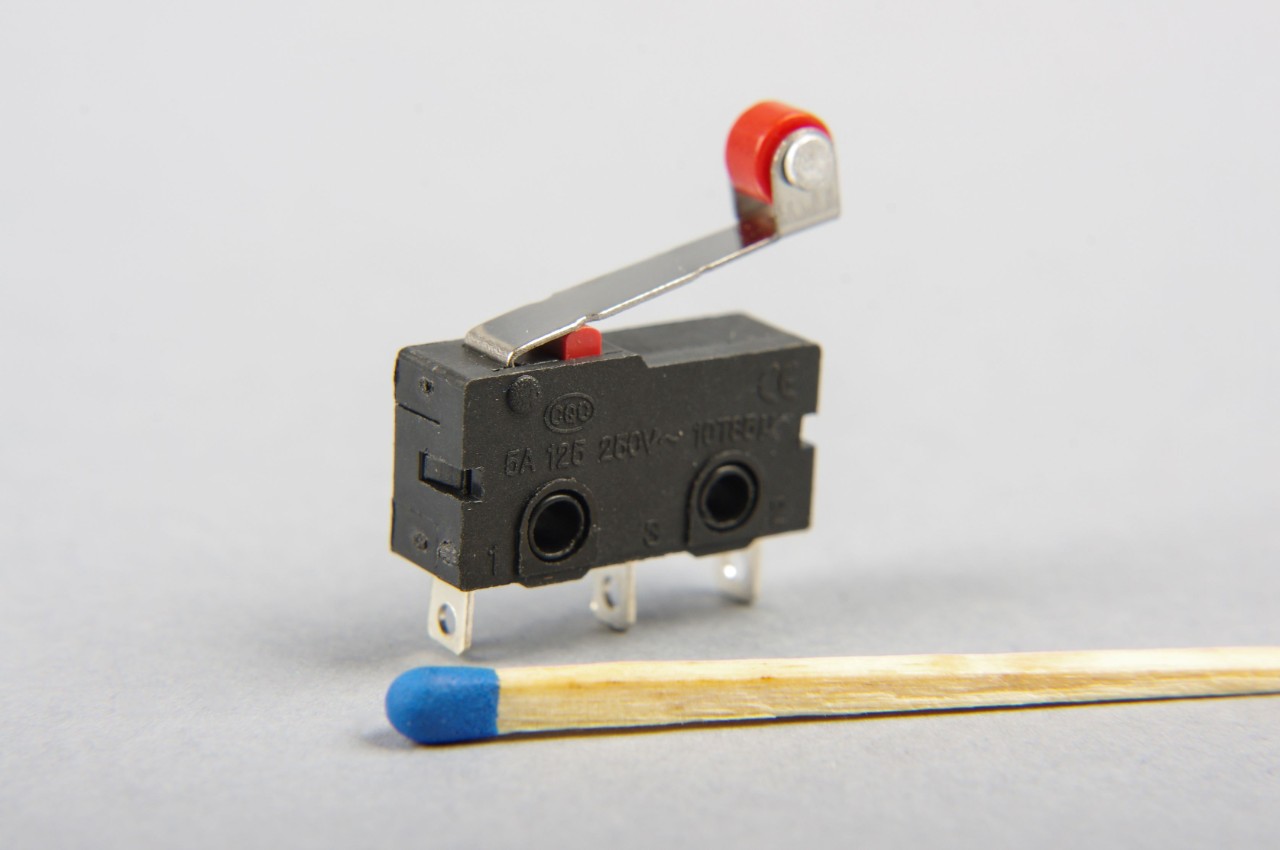 Microswitches are very small and require little physical force to enable basic device functions
Microswitch Applications
- Home Appliances: Microswitches are used for door locks, safety interlocks, and control panels on home appliances like microwave ovens, washing machines, and refrigerators.
- Automotive Industry: Microswitches are utilized in critical components of automobiles for brake pedals, door locks, and power windows to ensure safety for drivers and passengers.
- Industrial Equipment: Microswitches are used in industrial machinery for limit sensing, position detection, and emergency stop applications to halt equipment in case of malfunctions.
- Gaming and Electronics: Microswitches are essential for tactile mechanisms inside gaming controllers and computer peripherals. Microswitches also support printers and photocopiers, enabling accurate paper feed and detection processes.
 Microswitches in car door handles open and close doors
 Microswitches in computer peripherals are activated with low force
In Conclusion
Some notable manufacturers of microswitches include Honeywell, Omron, C&K Switches, and TE Connectivity. These manufacturers produce microswitches with the crucial role of swiftly and accurately responding to mechanical triggers when activated. Microswitches serve as the silent heroes behind our everyday electronic conveniences at just the flip of a switch.
Looking to buy a particular Microswitch?
If you have any questions, call TTI’s customer support at +86 400-844-4868.
Click here to see all the Microswitch-related products that TTI sells.
- Search all Honeywell Microswitches
- Search all Omron Microswitches
- Search all C&K Microswitches
- Search all TE Connectivity Microswitches