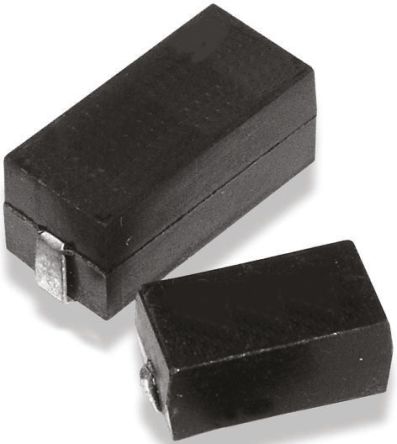
Small, with High Reliability
We offer a wide variety of surface mount resistors, also known as surface mount devices (SMD), including resistors suitable for pulse, surge, and voltage applications. Our standard thick film surface mount resistors offer power ratings of 6W and molded resistors to 7W. Our small SMD power resistors save space from traditional leaded products and offer a range of SMD thin-film resistors with both NiCR and TaN film technology.
A surface mount resistor is a tiny rectangular ceramic body with silver conductive edges on either end. Also referred to as surface mount technology, an SMD resistor offers advantages in saving space on printed circuit boards (PCBs). It features the resistance value code printed onto it, where there is space. Solder paste is printed onto the mounting pads of a PCB, and the resistors are placed automatically onto these pads by pick and place equipment. The whole board is then passed through a reflow oven which melts the solder into place, making the contacts.
A surface mount resistor provides the same functionality as the more traditional axially leaded resistors but has a lower power dissipation capacity and oftentimes a lower stray inductance and capacity. Surface mount resistors can be thick film, which is most commonly used, thin film, which offers accuracy and stability, metal strip, for current sensing, or wirewound, which is molded construction as opposed to a flat chip.
Surface mount resistors are used in large quantities and are the preferred resistor for use in electronics equipment, because of the small size and high reliability. Surface mount resistors are commonly used in telecommunication, automotive, and medical equipment, as well as in personal devices, displays, and advanced technology research instruments.
- Advanced Catheter Systems
- Embedded Computing
- High-Performance Petrochemical Solutions
- Laser Processing
- Low Power and Signal Applications
- Programmable Logic Controller
- Propulsion and Power Distribution
- Seeker and Guidance
- Solar Energy
- Solutions for CO2 Emission Reduction
SMD stands for Surface Mount Device. An SMD is any electronic component that is made to use with Surface Mount Technology (SMT). SMT was developed to meet the ongoing demand for printed circuit board (PCB) manufacturers to use smaller components that are faster, more efficient, and cheaper. SMDs are smaller than through-hole resistors and instead of having wire leads that go through PCB, they have terminations that are soldered to pads on the surface of the board. This eliminates the need for holes in the board and allows both sides of the board to be used more fully.
SMDs are made by placing end connection electrode bases onto an alumina or ceramic substrate. The resistor is then fired to ensure the electrodes are held in place. Next, a film of resistive material is printed or deposited and the resistor is fired again. The resistor is then covered with successive layers of a protective coat that dry between applications. These layers prevent mechanical damage and ingress of moisture and other contaminants. Finally, a marking is placed on the resistor if the surface is large enough. The resistors are packaged in a form of blister roll for use on pick and place machines, or they can be supplied as loose components.
One of these terms is a device and the other is a process. A SMD, or surface mount device, is an electronic resistor you would find on a printed circuit board (PCB). SMT, or surface mount technology, is the method of placing components such as SMDs onto a PCB. Production speeds up using SMT as opposed to older through-hole technology, but the risk of defects also increases because of SMD miniaturization and denser packing of boards. An SMT is smaller than a through-hole PCB because it has either small leads or no leads at all.
Because SMDs are tiny, they are marked with three- or four-digit codes called SMD Resistor Codes that indicate their resistance values. With a three-digit SMD code, the first two numbers indicate the significant numbers of resistance. The third number will either be a multiplier that must be multiplied by the first two significant numbers, or it will indicate how many zeros should be added to the first two numbers. The letter “R” is used for the decimal point. Resistances below 10 ohms (Ω) do not have a multiplier. Reading 4-digit codes is the same except there are three significant numbers, rather than two, with the last still indicating the multiplier or how many zeros to add to the first two numbers.
Advantages of SMDs include their smaller size, much higher component density, more connections per component, and a simpler and faster automated assembly. Additionally, components can be placed on both sides of a printed circuit board (PCB), fewer holes need to be drilled into a PCB, they have better mechanical performance under shock and vibration conditions, and many SMT parts are cheaper than through-hole parts.
SMD solder components can get damaged by potted compounds going through thermal cycling, SMT may be unsuitable as the sole attachment method for components that may encounter frequent mechanical stress, and many types of SMT component packages cannot be installed in sockets, which allow easy installation or exchange of components. Additionally, manual prototype assembly and component repair is more complicated and requires skilled workers and more expensive tools. SMDs have less surface area for marking, requiring part ID codes or component values to be smaller and more cryptic. Lastly, SMDs cannot be directly used with plug-in breadboards. They require either a custom printed circuit board for every prototype or mounting the SMD on a pin-leaded carrier.